
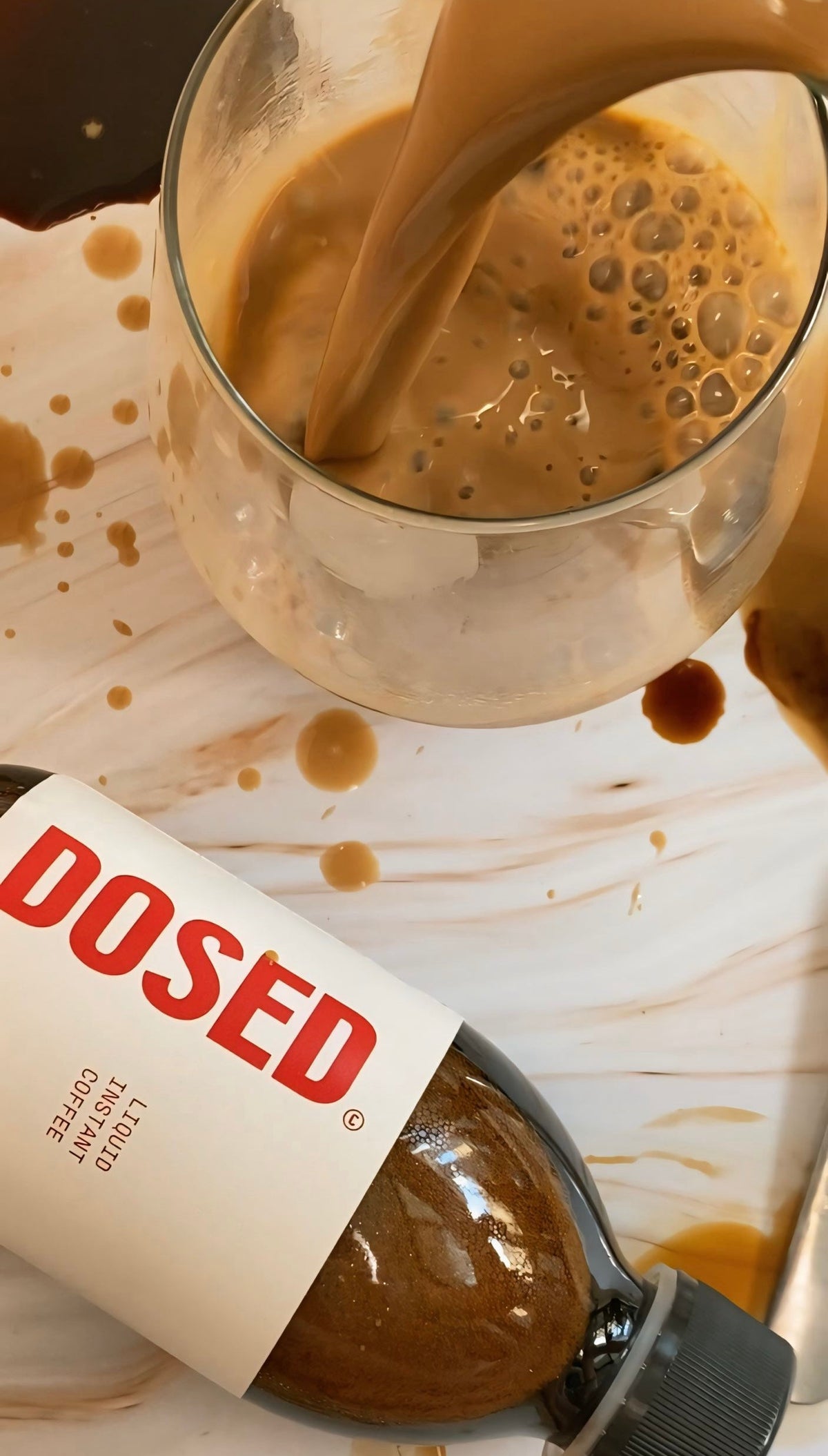
Liquid coffee concentrate tastes noticeably better than instant coffee powder, and there's a simple reason for it. Instant powder is made by completely drying brewed coffee, usually with high heat, which strips out the natural oils and volatile compounds that give coffee its depth and aroma. Liquid concentrate is never dried at all. It stays in brewed liquid form, so those flavour compounds survive intact.
If you've been putting up with flat, slightly burnt-tasting powder instant, the difference is real, not marketing.

Real brewed coffee in a bottle. Original Bean, Vanilla Bean, Decaf, or Caramel. 15 x 13ml serves per 200ml bottle, cafe quality in 30 seconds.
What is liquid instant coffee, and how is it different from instant powder?
Both solve the same problem: cafe-quality coffee without a machine or a five-minute brew. But they go about it very differently.
Instant coffee powder is brewed coffee that has been fully dehydrated into soluble granules or crystals. Cheaper versions use spray drying (high heat, fast, but flavour-stripping). Better versions use freeze drying (gentler, better taste, higher price). Either way, you end up with a dry powder you dissolve in hot water or milk.
Liquid coffee concentrate is real brewed coffee that has been reduced down to a highly concentrated liquid. Nothing is dried. You measure out a small dose, add hot or cold milk or water, and you're done in about 30 seconds. The process is gentler, and the cup actually tastes like something you'd order at a cafe.
Why does instant coffee powder taste the way it does?
The short answer: the drying process.
Spray drying uses extreme heat to quickly evaporate water from brewed coffee. That heat destroys the volatile aromatic compounds and natural oils responsible for aroma and depth. The result is a powder that dissolves quickly but tastes flat, one-dimensional, and sometimes slightly burnt.
Freeze-dried instant coffee is better. The cold-temperature process preserves more character, which is why freeze-dried options taste noticeably better than standard granules. But even freeze-drying isn't as gentle as simply not drying the coffee at all.
There's also the beans question. Large-scale instant coffee production runs on cost efficiency, and lower-grade robusta beans are common. They bring more bitterness and less complexity than the specialty arabica that goes into concentrate and cafe brewing.
How does liquid concentrate compare to instant coffee, head to head?
| Liquid Coffee Concentrate | Instant Coffee Powder | |
|---|---|---|
| Taste | Rich, full-bodied, cafe-like | Flat to mildly bitter; better freeze-dried |
| Flavour preservation | High (never dehydrated) | Low to medium (drying strips flavour compounds) |
| Prep time | 30 seconds | 60 to 90 seconds |
| Versatility | Hot, iced, lattes, desserts | Mainly hot |
| Cost per cup | $1.99 per serve (less with a bundle) | $0.10 to $0.20 per serve |
| vs a cafe latte | About 70% cheaper | 95%+ cheaper |
| Equipment needed | None (jigger optional) | Kettle only |
| Shelf life once opened | 2 to 4 weeks, refrigerated | Months, dry and sealed |
| Packaging | Glass reusable bottle | Plastic jar |
The cost gap is real, and worth being straight about. Instant powder wins on price per cup by a long margin. But the comparison that actually matters for most people is not "concentrate vs powder" in isolation. It's "concentrate vs going to a cafe every morning." At $1.99 a serve (or less with a bundle), Dosed is still dramatically cheaper than a $5.50 to $6.50 cafe latte, while delivering a result that's genuinely close to the real thing.
"I honestly didn't have great expectations, but thought I'd give Dosed a try for the convenience factor. Verdict: surprisingly good taste and will be perfect for both the campervan where space is precious and work where time is precious. 15 coffees out of one small bottle is great! Coffee in a flash without the horrible 'instant coffee' taste."
Is liquid coffee concentrate more convenient to use than instant?
This is closer than the taste question, and it depends on what you're used to.
Instant powder has the lower floor: boiling water, a mug, a spoon. No refrigeration, no measuring. That's genuinely useful in an office kitchen or when you're travelling light.
Liquid concentrate sits just above that. A small measuring dose, your milk or water, and you're done in about the same time. The main trade-off is refrigeration once opened, and a 200ml bottle is less portable than a sachet.
For everyday home use, the difference in convenience is basically nothing. For travel or camping, powder has the edge on portability. That's exactly why Dosed makes a 60ml travel bottle.
Which one should you actually choose?
If taste is the priority, and you want something that works for a proper iced latte as easily as a morning flat white: liquid concentrate, no contest.
If the price per cup is non-negotiable, you're hiking off-grid, or you genuinely don't mind the taste of powder: instant does the job.
For anyone who has been drinking powder out of habit rather than preference, trying a concentrate tends to be a one-way door.
"I am a big espresso coffee fan, and have my own espresso machine. However I'm impressed with the taste of Dosed, and love how smooth it is. No sugar required! It mixed well with my frothed cream and collagen powder which is my morning coffee ritual. Great product, and I love that it's made right in Melbourne!"

Try all four flavours (Original Bean, Vanilla Bean, Decaf, Caramel) before committing to a full bottle. Perfect for travel, too.
Frequently asked questions
Is liquid coffee concentrate stronger than instant coffee?
Yes, typically. Liquid concentrate is undiluted brewed coffee, so it carries more caffeine and flavour intensity before you add milk or water. A single dose of Dosed is roughly equivalent to a double espresso. Most instant powder is designed to be considerably milder.
Does liquid coffee concentrate taste like real coffee?
Much closer than instant powder does, yes. Because it's never been dehydrated, concentrate retains the natural oils and aromatic compounds that give brewed coffee its depth. Instant powder, especially spray-dried varieties, loses a significant portion of these during processing.
How long does liquid coffee concentrate last once opened?
Refrigerate after opening and use within 2 to 4 weeks for best flavour. Unopened, the shelf life is several months, so it's easy to keep a spare on hand.
Can you make iced coffee with liquid concentrate?
Yes, and it's one of its best uses. Pour a dose over ice, top with cold milk, and you're done in 30 seconds. No waiting for hot coffee to cool down first, and no watery dilution from melting ice.
Is coffee concentrate worth the extra cost compared to instant powder?
Compared to powder, yes, concentrate costs more per cup ($1.99 vs $0.10 to $0.20 per serve). But compared to a cafe latte at $5.50 to $6.50, Dosed is significantly cheaper while delivering a result that's genuinely close to the real thing. Most people making the switch are comparing it to the cafe, not to the jar of powder.
What drinks can I make with liquid coffee concentrate?
Lattes, flat whites, cappuccinos, iced coffees, cold brew-style drinks, and even desserts like tiramisu or coffee cake. The concentrated form gives you flexibility that powder simply can't match.
Ready to ditch the powder?
Try Dosed Liquid Instant Coffee and taste the difference for yourself. Available in Original Bean, Vanilla Bean, Decaf, and Caramel.
Shop Dosed →
Share:
What's the Best Coffee for the Planet?
Coffee Concentrate vs Instant Coffee: Which Is Better?